Recent advances in blood-based biomarkers are transforming the assessment of cognitive decline and Alzheimer’s disease. The Healius Pathology Network offers blood tests that may support clinicians in the investigation of cognitive decline and Alzheimer’s-related amyloid pathology.
Blood-based biomarkers can support the early evaluation of cognitive decline by helping to identify patients who may have underlying Alzheimer’s-related amyloid pathology and who may benefit from further specialist investigations, including amyloid PET imaging or cerebrospinal fluid (CSF) analysis.
These tests may be considered in patients presenting with:- Subjective cognitive decline
- Mild cognitive impairment (MCI)
- Suspected Alzheimer’s disease
- Progressive cognitive symptoms
These blood tests assess the likelihood of Alzheimer’s-related amyloid changes. Results complement clinical and cognitive assessment, specialist review, amyloid PET imaging or CSF analysis may still be required.
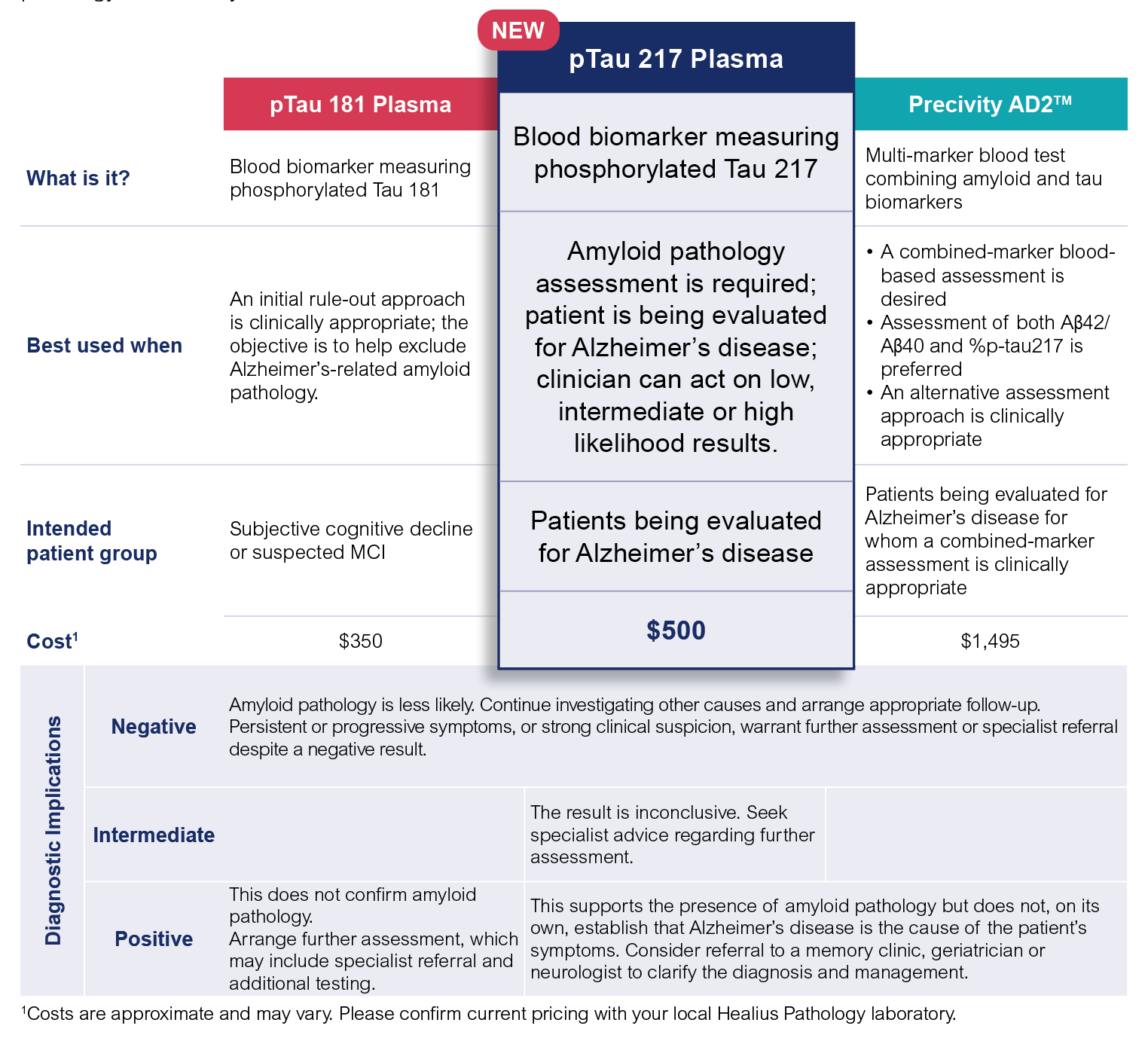
pTau 181 Plasma
An optional initial rule-out biomarker. A low result suggests a lower likelihood of
Alzheimer’s-related pathology but should not override persistent symptoms or
strong clinical concern.
pTau 217 Plasma
Assesses the likelihood of amyloid pathology as low, intermediate, or high.
Intermediate results are indeterminate and require further clinical evaluation.
Precivity AD2™
Combines the Aβ42/Aβ40 ratio and phosphorylated-to-non-phosphorylated
tau217 ratio (%p-tau217) in an algorithm to assess the likelihood of amyloid
pathology.
Use this table to choose the appropriate blood test based on the clinical question: rule out Alzheimer’s-related
pathology, assess amyloid likelihood, or use a combined-marker assessment.
To order, request pTau 181 Plasma,
pTau 217 Plasma or Precivity AD2 on a
Healius Pathology request form.
1. Palmqvist S, Whitson HE, Allen LA, et al. Alzheimer’s Association Clinical Practice Guideline on the use of blood-based biomarkers in the diagnostic
workup of suspected Alzheimer’s disease within specialized care settings. Alzheimer’s & Dementia. 2025;21:e70535.
2. US Food and Drug Administration. Elecsys Phospho-Tau (181P) Plasma: 510(k) Decision Summary, K252163. 2025.
3. Roche Diagnostics. Elecsys Phospho-Tau (217P) Plasma: Instructions for Use. Document 10285583500, version 1.0, April 2026.
4. Meyer MR, Kirmess KM, Eastwood S, et al. Clinical validation of the PrecivityAD2 blood test. Alzheimer’s & Dementia. 2024;20:3179–3192.
5. Coppinger J, et al. Independent validation of the PrecivityAD2™ blood test. npj Dementia. 2025;1:23.
6. Dementia Australia. Assessment and diagnosis of dementia. Guidance for health professionals.
Article updated 07/10/26